

A lullaby does not have to stay soft. Some of the most lasting ones hold a pulse under the hush, the kind of heartbeat that stays with you after the room goes quiet. Emma Back’s Juniper Tree Lullaby sits in that space: dark pop intimacy, glitch hop texture, and a global bass low end that never quite lets the song drift away.
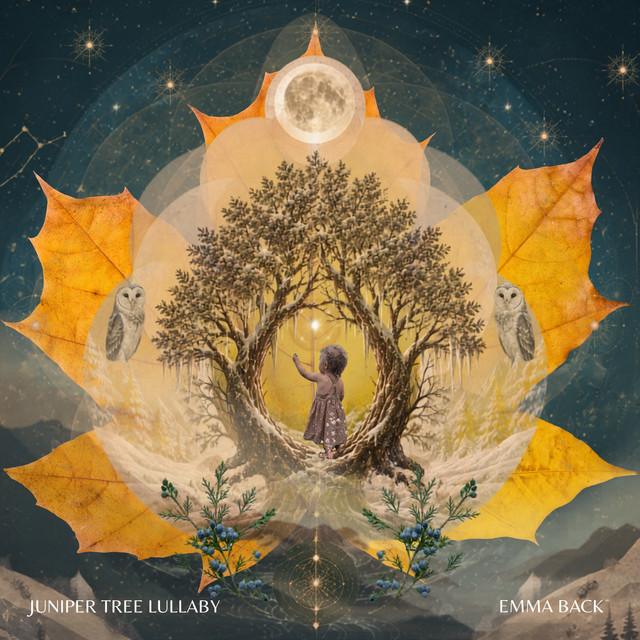
The track is vocally driven and deliberately close. Lush layers of strings and synth sit over a steady heartbeat kick and droney bass lines. It stays soothing and heart-opening, balanced between softness and intensity. The arrangement opens spatially in the bridge, builds through the breakdown, and lands in a final release of harmonized voices wrapped in atmospheric textures. Nothing here feels rushed. The production keeps the vocal at the center while the electronics and strings widen the room around it.
Back wrote the song for her daughter, Juniper, and timed the release for the child’s second birthday on September 20, 2026. Born breech and dancing, Juniper is the person the song calls home: resilient, strong, joyful. The title points to the medicine of the juniper tree, a plant long associated with purification and protection. That image is not decoration. It is the frame Back uses for a message about strength held with tenderness.
The recording itself is a small domestic timeline. She self-produced it in her tiny-house-on-wheels studio in Vermont over nine months, first while singing Juniper to sleep, then in stolen moments during naps, after bedtime, and even while nursing. That detail matters for how the song feels. Dark pop and glitch hop often arrive as studio architecture, all design and distance. Here the architecture was built around sleep schedules. The heartbeat kick reads less like a club device and more like a body in the room. The drone bass holds the floor while the strings and vocal harmonies do the emotional work.
Listeners who know Back’s earlier work will hear a clear line back to Little World, her 2018 debut. That album blended acoustic instrumentation with percussive loops, vocal and string harmonies, and Eastern European tonalities, written across a period of health crisis, return to Vermont, and questions about conflict, ancestry, and connection. She came up on classical violin and voice, performing since age seven, and fell early for Balkan and African music through Village Harmony. Studies in avant-garde improvisation, composition, and vocal performance at Naropa University led to the 2011 EP C’est Nous. Live, she has used a loop pedal to stack strings and Balkan- and African-inspired percussion under melodic lines that have drawn comparisons to Björk, Tori Amos, and the spacious urgency of Andrew Bird. She also founded She Sings Out Loud, supporting female-identifying singers and performers in finding authentic expression onstage.
Juniper Tree Lullaby does not replay that catalog. It takes the string-and-voice instinct and sets it against glitch hop and global bass colors: heartbeat kick, drone, spatial bridge, harmonized release. Global bass has spent years pulling club low end toward diaspora rhythm and ceremonial weight. Dark pop keeps doing the opposite of spectacle, favoring intimacy and shadow. This track borrows from both without pretending to be a festival weapon. Back frames it as a song for mothers, for children, and for anyone who wants to connect with the little girl within and remind her of her strength, with care rather than force.
Independent artists working at this scale, between nap windows and a rolling studio, still need a clean path to listeners. DistroKid makes it simple to distribute tracks to major platforms, and you can get 7% off membership with this link: https://distrokid.com/vip/seven/2058328. It is a practical way to reach more people and keep more of what the music earns.
What do you hear first in Juniper Tree Lullaby, the heartbeat kick or the harmonized voices? Let me know in the comments.
